
In the aftermath of a relentless Ontario winter, I traveled to Alqonquin for a few days in early April for the annual OFO outing and had a fabulous time. One of my most rewarding moments was an encounter with a male Black-backed Woodpecker all on my own, ahead of the eighty club members arriving at Spruce Bog Boardwalk:

The Black-backed Woodpecker is one of Algonquin's prized boreal species, and it had been two years since I had seen one of these beauties. It was also the first time I'd ever seen one in a natural setting, as my only other sightings had always been on a hydro pole! The male's yellow cap is accentuated by his solid black back:

It was also the first time I observed its behaviour of peeling off the bark to feed on beetle larvae:

Another good view of him showing the barring on his side:

He didn't do so well in the food department on this stump:

Watching him in action as he removed a large piece of bark:

...the bark floated to the ground as he searched for larvae in the exposed trunk:

I continued watching him while continuing on to the suet feeder when a male Spruce Grouse landed at my feet, I was astonished!


...deciding whether or not to leap up into a tree:

Decision made! His bright red combs brightened up the forest:

A black and white view of his striking undertail coverts:

The Spruce Grouse Strut!

I spent fifteen minutes with this fellow before leaving him on his own to find a suitable mate:

Fortunately for OFO members, both the Spruce Grouse (including a female) and Black-backed Woodpecker were later seen by most members, and in fact were Lifers for several.
Gray Jays are always a challenge to find at this time of year as they're already on the nest, but this one along Opeongo Road entertained us all, cleaning up its beak on the branch after stashing away some treats:


Eager to enjoy any treats that come their way, this porker Gray Jay stuffed itself with snacks:

We had almost given up on any Boreal Chickadee sightings but Justin's keen hearing detected one that eventually landed high up in a spruce:

Not everyone had seen the Black-backed Woodpecker yet so the group returned to Spruce Bog Boardwalk and eventually this female was spotted across the road from the parking lot, excavating a hole in a hydro pole. The female lacks the male's yellow cap, but for the first time I noticed a wisp of white above the corner of her eye:

The male also had the same white wisp:

At this point I left the group to begin my Moose Hunt, changing from birding mode to mammal mode. After last autumn's amazingly close encounter with a pair (which has yet to be blogged about!), I feared my Moose drought was back, so imagine how thrilled I was to eventually see one, barely, as he was incredibly camouflaged:

...a bit easier to see here, but only if you knew where to look for him:


Reaching up for some small branches:

...as he finally made his entrance, I gasped as their size is incredible:


A full view of him, notice the new antlers growing in:

It wasn't until I reviewed this next photo that I noticed his right eye was somehow damaged, best seen by double-clicking on the photo to enlarge:

Moose are prone to outbreaks of winter ticks, small parasites that attach themselves to the Moose and start feeding. The missing fur patches are the result of the Moose rubbing themselves against trees in an attempt to rid themselves of these parasites:

One of my reference guides says that sometimes a single Moose can have up to 50,000 or more ticks living on them, yikes!

He waded across the icy water:


...and climbed back onto land in the snow, disappearing into the bush, giving me five exciting minutes of viewing:

Ten minutes later a second Moose was seen, thanks to the OFO gang that had gathered to watch him. I have to admit this was my favorite fellow to observe, spending a good twenty minutes with him, some of which was just the two of us:

This is where I now ask you to either indulge me or just stop reading, as I took a crazy amount of photos of him. In no particular order, here goes (and these are the keepers, too hard to decide what to leave out):


Fresh antlers are beginning:

Mud:

Beautiful!


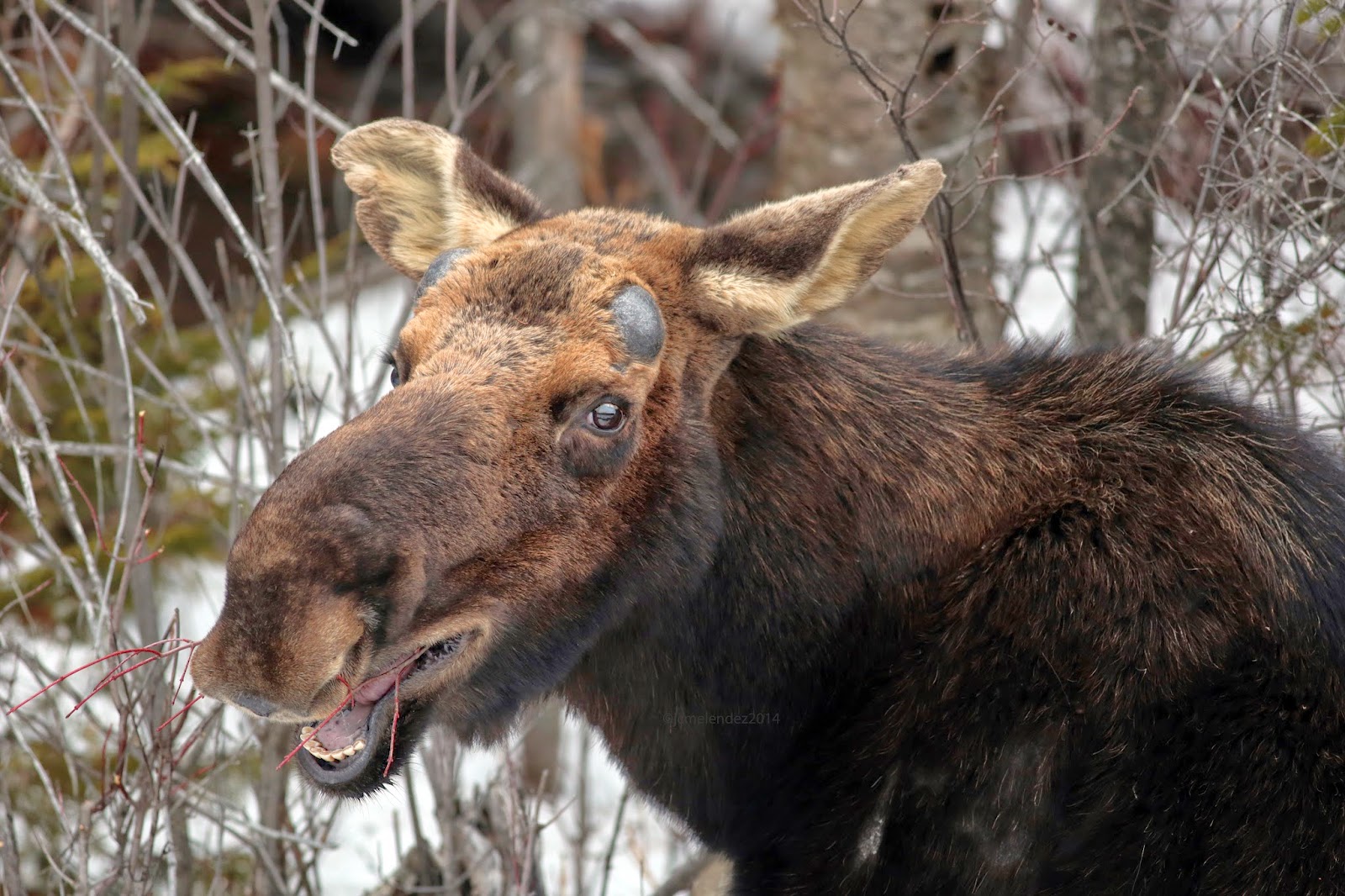
Mr. Congeniality, such a character:


Choppers! Lower ones only, as they don't have upper incisors:
Moose are the largest members of the deer family (who knew?? not me), which this view of his ears from behind reminded me of:


"I think I fell in love we're alone now".
By now the crowds had all moved on but it was impossible for me to leave, so for the next short while I sat quietly on the guardrail to watch him:


So remarkably adept at bending small branches:

...and then grasping the branches between his lower incisors and upper palate, and next moving his head up and back to tear them off:


...and then munching away on the branches he'd worked so hard for, between occasional snorts!


A rear view of wet and muddied Moose stilts:

He moved on to some cedars:


Nibbling on cedar:

...with a watchful eye on me:

All of it leading up to my final farewell to Handsome, as we exchanged a parting glance:

And I admit to still giggling away at some of these photos freak as I look back on this incredible moment with him!
Now if you're still with me, my third Moose was seen just a few minutes later right on the highway and was understandably more skittish (as was I!) than the others, as there was nothing between him and the few who had gathered to watch him in awe:


Sodium-starved, he drank salty water from a shallow ditch:

Drips:

I wasn't entirely convinced that the photographer in the background would have been able to make a hasty retreat had the Moose changed direction as he was now on the move, but he gives the Moose some size scale:

Their shoulder height is about 2 metres, weighing in between 300 to 600 kilograms, and the male is larger than the female. Be respectful.

A view of him with my toy camera, taken from behind my car for protection:

Feeding time again as he checked out small branches:


Nibbling away:

Face forward, full frame:


Oncoming traffic distracted his feeding, so he crossed back across the highway, returning to the safety of the bush:

What a fabulous way to end an amazing day in The Park!
The next morning, after seeing my first Yellow-bellied Sapsuckers for the year, and more Gray Jays, I stopped in at Spruce Bog Boardwalk ahead of the incoming drizzle and rain. I immediately ran into Jean and Eleanor who were still recovering from a unique encounter with a male Spruce Grouse who landed on Jean's shoulder! I don't know of many people who can tell that story!! No doubt this was the fellow:

I kept a safe distance from him as I didn't exactly want him landing on me next, but he still checked me out!

...and there's that strut:

Foraging for nibblies:

My final views of him for the day as the rain had begun:

As I left Alqonquin, an open patch of water was found with Canada Geese and Common Mergansers:

En route to the Kawarthas via my usual where-the-heck-am-I back roads, a herd of White-tailed Deer enjoyed a peaceful graze:

Many more screaming Osprey had arrived back at my lake, here's one of a dozen I saw:

They're back on my favourite nest!!! This is a good size comparison of the smaller male next to the female:

The resident Pileated Woodpeckers continued their excavation rampage at the cottage:

Oddly, I didn't see or hear any of them during this visit, but a male was seen during an earlier cottage run:

One can look right through one of the holes in this cedar to the other side!

At the back swamp a Red-winged Blackbird was perhaps equally ticked off that the lake was still frozen solid sang:

An unexpected and first cottage sighting of a pair of Trumpeter Swans, their beautiful calls echoing across the frozen lake:

I'm hoping to see a lot more of this healthy Fox who's been frequenting the area quite close to the cottage, time will tell!

And so ended an exhilarating few days outside of civilization, as I anxiously await my next wild expedition!


