Totally captivated in 2007 by the live camera feed of the Hornby Island nesting Bald Eagles in B.C., I was drawn into birding and have never looked back. Thus begins my account of what I'm fortunate enough to discover each day and perhaps capture with my camera.


Unless otherwise stated, all images were taken by and are the property of Janice Melendez

Species Counts:

2014 Final Year List: 255; 2015 Year List a/o June 5, 2015: 235; Life List: 327

Sunday, July 4, 2010

Rouge Park- Wednesday, June 30


Doug and I began the day at Rouge Beach, where the promised nesting Cliff Swallow colony was easily found. Yes, they will nest under overhanging ledges on rocky cliffs, hence the name, but also on man-made structures like under this bridge. With the winds I found them incredibly difficult to photograph, combined with their quick, swooping flight, so consider yourself warned:


Two swallows both trying to fit into the jug-like nest made out of mud, a tight squeeze!


My total count is FIVE for the number of swallows here in these four nests:


In Rouge Marsh, I finally saw my first Great Egret for the year:


John joined us so we departed for the Twyn Rivers area of Rouge Park, finding it very quiet on the bird front, other than Black-capped Chickadees, a Great Crested Flycatcher, Northern Flickers, Cedar Waxwings, and at last a nice visual for the year of a singing Indigo Bunting.


Here's Doug's feeble attempt to get me into BOTANY instead, nnooooooooooo :


I continue vehemently denying that the impending summer dead-zone of birding is upon us, but now realize by the lack of bird photos, IT IS HERE, waaaaaaaaaaaaaaah. Is it so bad that I'm now shooting snail shells??


Just smack me now, let's go back to butterflies and dragonflies, a Little Wood-Satyr for starters:


Red Admiral:


Northern Pearly-Eye:


Northern Broken-Dash Skipper:


Canada Darner:


We finished our day down by the lake, I had never seen a Baltimore Oriole nest before, what a work of art it is, so intricately woven!!


Several Northern Mockingbirds were in attendance, including this juvenile:


So ended the day, but so begins my summer doldrums without the birds :-(


Saturday, July 3, 2010

Heber Down, Whitby Harbour, Carden Alvar- Monday June 28, 2010


After enjoying great views of the American White Pelican at Second Marsh, Doug and I were joined by Alan and continued on to the Heber Down area in north Whitby, an area I've never been to before despite it being mere minutes from home:


As we parked east of the Conservation Area, another car pulled up and Jim McN joined us, so off the four of us went along the hydro lines. It was an open area, so the sun, heat, and humidity were setting in, but we were rewarded with several Veery singing away, as well as a male Rose-breasted Grosbeak that flew in upon our arrival:


American Goldfinches were plentiful...


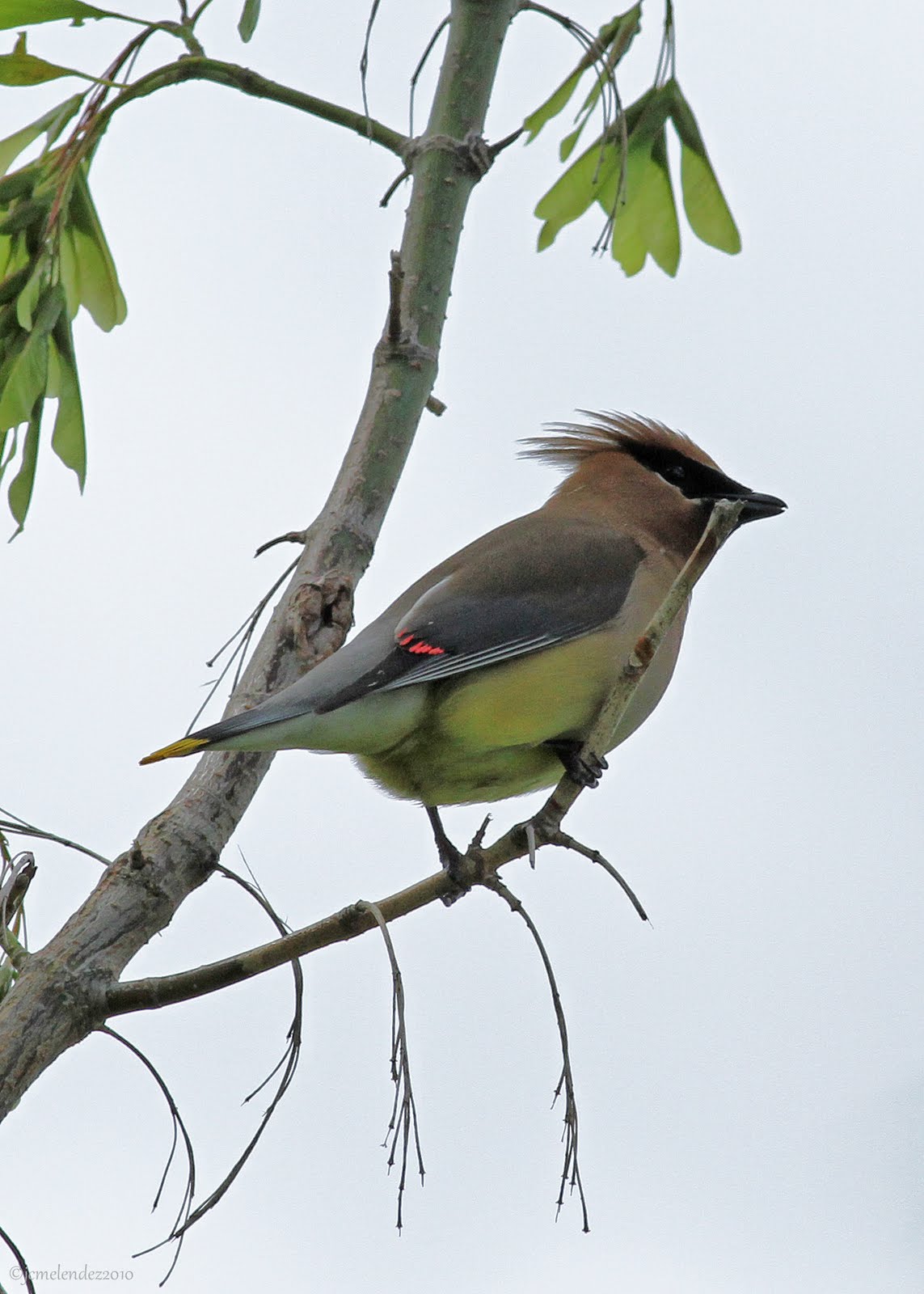
...as were Cedar Waxwings:


Three metallic birds also flew overhead, we each made bets on the citizenship of the passengers, perhaps departing G20 delegates??


So you know the birding world is reaaaally slowing down now, based on the number of insect photos that you'll be subjected to for the next several weeks, here's a Northern Crescent butterfly:


An Eastern Comma butterfly tortured me at the parking lot, rarely spreading its wings, but upon closer inspection of this photo, the silver "," was visible in the first shot:


Alan headed home, but Doug, Jim and I went into the Conservation Area proper, and followed the trail along the creek in pursuit of report Mournng Warblers:


Beautiful Ebony Jewelwings decorated the river banks:


We dipped on the warblers in the end, and as Doug and I we were ill-prepared for the heat, we called it a day. Or so I thought.....  


After dropping off Doug, I made a hit-and-run stop at Whitby Harbour for the Purple Martins who were oblivious to my presence, as well as the presence of House Sparrows in the bottom level of their condo:


The Purple Martin is North America's largest swallow and its diet is insects, but it looks like this male below decided to bring the insects home in some green gift-wrapping:


Ditto with this one, choosing yellow instead:


Check out the colour purple:


I'm thinking that this is a juvenile on the right, and below, versus a female, will have to pay more attention next time:


So ended my Day, or so I thought, the Twitch factor is imbedded in me now......


John and Doug picked me up at 6:30 p.m. and we headed to Carden Alvar, timed to arrive at our final destination, "Goatsucker Alley", by sunset. With the heavy rains of the past few days, we encountered flooded sections along Wylie Road, making it quite adventurous at times, as I was seated in the back of the van with the door wide open (shhhhhhhhhhhhhh!) to get better views of the "usual suspects", including this Wilson's Snipe at the Golden Hour:


We heard and/or saw Kingbirds, Common Yellowthroats, an Eastern Towhee, American Robins, Red-winged Blackbirds, Eastern Meadowlarks, and Savannah Sparrows, to name a few. Was also a delight to see the area at dusk once again:


At sunset, we left Wylie Road for Goatsucker (I just shudder at the thought of the image that word conjures up!) Alley, aka Doyle Road, but I had to take a sunset pic on Wylie Road first: 


As we arrived at Doyle Road, we found that there were already other freaks birders present, a few who were fellow members of the Pickering Naturalists. Dressed in varying degrees of insect armour as the mosquito onslaught had begun, almost like clockwork around 9:15 p.m. did the rare Chuck-Will's-Widow begin to call on the south side of the road, we were thrilled! He continued to call along the road for about half an hour max, occasionally changing position in the woods, but we never were able to actually see him. Didn't matter.

We also learned a tip: if one cups both ears, it seriously magnifies the sound, and in doing so, we were able to easily hear the first "chuck" note that at times is very low and tough to hear. Shortly afterwards, we heard a Whip-poor-will's call as well, so our late-day trip was well worth it in the end, adding another Lifer to my list! 


Tuesday, June 29, 2010

The Pelican Brief- Second Marsh, Oshawa


Doug and I went to Second Marsh yesterday morning for a few hours, and I returned again today to take advantage of the clear(er) skies for more shots of this lone American White Pelican that was first reported here on Saturday. Nice Lifer, eh??? 

He spent his time on a log resting and then preening himself, and once the hunger set in, he began to forage for small fish in the marsh by plunging his massive bill into the water. I was shocked by his size, we could see him naked eye from the path as a "big white blob" (my highly scientific term that made Doug, a retired high school teacher, cringe). Today as I arrived, I decided to see if I could see him from the road as I drove in, and I could, he's that huge!

So here goes, please bear in mind he's quite a distance away from the viewing platform, so the photos will win no awards, but are rather more for my records:


The wing span on these waterbirds is an astonishing nine feet, check this out, the black tips are a nice contrast to the white plumage and yellowish bill and pouch:


Preening session:


On the water now:


When I was editing my pics, I noticed something on the top of the bill, which is apparently (here goes, Doug!) "a fibrous epidermal plate toward the tip, that grows in the breeding season but is much reduced at other times", the theory is that it's important in displays. HUH.


Here he is fishing, with a pair of Trumpeter Swans in the foreground, to help put his size in perspective:


Speaking of other species, during any cloudy periods this morning, I removed my camera from the tripod and wandered around below the viewing platform. At one point I looked back up at the tripod, only to find this young thing looking for some "camera-time" too!


I caved for fear of a pooparazzi episode on my equipment, and quickly agreed to take its formal portrait on the railing instead, what a fine, young American Robin!


But back to the Main Event, that huge, extensible pouch can hold up to eleven litres of water!


Brunch is all done for now, so it's back to the log to clean up:


What a beautiful bird, we're all curious as to how long he'll stay around, as he's rare for here!


As I mentioned earlier, other birds kept me out of trouble during cloudy periods, including a Yellow Warbler...


...Common Yellowthroats...


...and Cedar Waxwings:


And so ends my not-so-brief Pelican Brief this week!


Sunday, June 27, 2010

Merlin in a Fog


As Robert and I savour our morning coffee on the dock at the cottage and patiently await the fog to lift, the resident Merlins are quite vocal, with one landing close to us, allowing for some photo opps despite the icky lighting conditions, enjoy:


P.S. Footnote to Thursday's Glen Major hawks, they have been confirmed as Broad-winged vs. Red-shouldered...thanks for clarifying on my behalf, Doug!